Investing from one eclipse to the next
From market crashes and global pandemics to political upheaval and inflation shocks, the past 27 years have been far from smooth. Donald Maxwell-Scott, Investment Specialist, explains how staying invested, making regular contributions and allowing time for growth could make a significant difference to long-term outcomes.

Donald Maxwell-Scott, Investment Specialist
"Over the past 27 years, investors have faced no shortage of reasons to step back from markets. Yet history shows that some of the most rewarding periods of growth have followed times of uncertainty. While no one can predict what comes next, staying focused on your long-term goals rather than short-term headlines has often proven to be one of the most valuable investment disciplines."
On 11 August 1999, millions of people across the UK watched the Moon pass in front of the Sun. Since then, investors have witnessed:
- the dot-com crash
- the Global Financial Crisis
- the Eurozone debt crisis
- Brexit
- Covid-19
- the inflation shock
- trade wars and tariffs
- geopolitical tensions in the Middle East
There were undoubtedly moments when these events cast long shadows over financial markets. Investors experienced periods of significant uncertainty and sharp market declines. Yet time and again, equity markets demonstrated a remarkable ability to recover and move higher.
For many people, these events felt unsettling at the time. When markets fall and headlines are dominated by uncertainty, it can be tempting to make decisions based on short-term concerns. However, history shows that staying focused on long-term goals has often been rewarded.
When viewing a solar eclipse, people are advised not to look directly at it. The same advice might apply to readers who missed out on equity returns between the eclipse of August 1999 and the one witnessed on 12 August 2026.
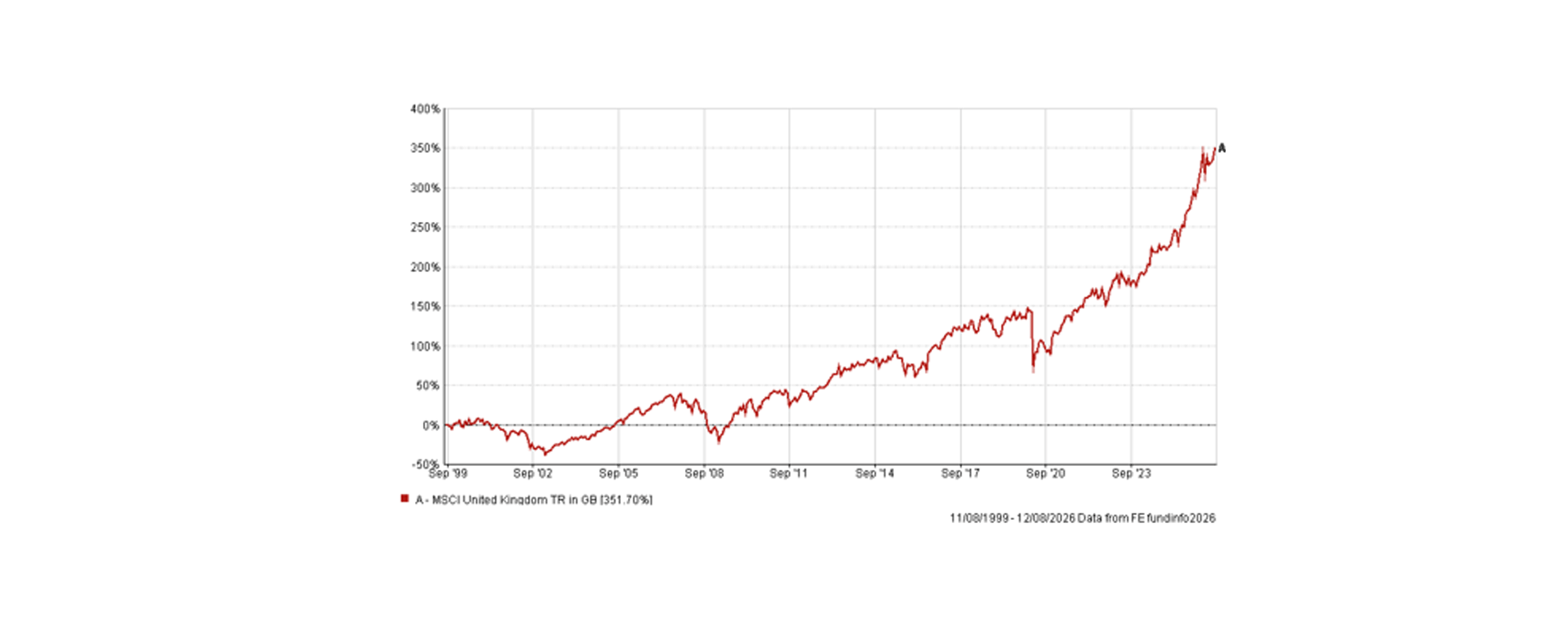
As the chart below illustrates, the MSCI United Kingdom Total Return Index delivered a return of approximately 351% over the period, despite every crisis, shock and gloomy headline along the way. While past performance cannot tell us how markets will behave in the future, it does demonstrate how markets have historically recovered from periods of uncertainty over the long term.
So, while an eclipse can last only a few minutes, the wealth creation delivered by patient equity investing has endured for more than 27 years.
This serves as a useful reminder that markets and economies are constantly changing. While periods of uncertainty are unavoidable, they are often just one chapter in a much longer story.
Coincidentally, 1999 was also the year the Stocks & Shares ISA was introduced, although its predecessor, the Personal Equity Plan (PEP), operated in a similar way.
The combination of tax-efficient investing and the power of compounding has proven to be a formidable one. It's important to remember that investments can fall as well as rise in value, and investors may get back less than they originally invested. Had an investor fully utilised their ISA allowance each year since launch and achieved returns in line with the MSCI United Kingdom Total Return Index, they would have contributed approximately £379,000 and accumulated a portfolio worth around £918,000 by August 2026.
While £379,000 of that total came from contributions, more than £539,000 would have been generated through investment growth. This example is intended to illustrate the potential benefits of investing over the long term and is not a guide to future performance or returns. The result highlights the twin benefits of long-term investing and sheltering returns from tax within an Individual Savings Account (ISA).
Although few people are able to invest the maximum allowance every year, the principle remains the same. Regular contributions, made consistently over time, can help build momentum and allow investment returns to compound.
Importantly, this outcome would not have required perfect market timing, stock selection or the ability to predict the next crisis. Instead, it relied on consistently investing and allowing time and compounding to do the heavy lifting.
This can be reassuring for investors. Investing is not necessarily about making bold predictions or reacting to every market movement. More often, it is about maintaining a well-considered plan and sticking with it through changing market conditions.
The lesson from one eclipse to the next is clear. Periods of darkness are inevitable, but history suggests they are usually temporary. For long-term investors, the greatest risk may not be enduring the occasional eclipse but missing the opportunities that emerge when the light returns. Of course, every investor's circumstances are different, and any investment decisions should be considered in the context of your own goals, time horizon and attitude to risk.
While the future will undoubtedly bring new challenges and periods of uncertainty, having a long-term perspective can help keep short-term events in context. As with an eclipse, the darkness rarely lasts forever.
Notes:
- The MSCI United Kingdom Total Return Index is used as a proxy for UK equity market performance.
- The increase in the ISA allowance during the 2014/15 tax year has been reflected by assuming the additional allowance was invested from the date the increase took effect.
Important information
This article is for information purposes only. It is not intended as investment advice.
Fees, charges and eligibility criteria apply.
Any views expressed are our in-house views as at the time of publishing.
This content may not be used, copied, quoted, circulated or otherwise disclosed (in whole or in part) without our prior written consent.