Are the Magnificent Seven still magnificent?
The Magnificent Seven have played a major role in driving market performance in recent years, but strong returns can sometimes lead investors to become overly concentrated in a small number of companies. Discover why diversification still matters and how a balanced investment approach can help you look beyond today's market leaders.

"The success of the Magnificent Seven has captured investors’ attention, but some of the most interesting investment opportunities can emerge when innovation begins to spread more widely across the market."
Donald Maxwell-Scott, Investment Specialist
Many investors will be familiar with the phrase ‘The Magnificent Seven’ and no, we are not discussing the famous Western of the same name, but rather a collection of seven US companies. If the phrase itself isn't familiar, then the underlying companies almost certainly will be. They are Apple, Microsoft, Nvidia, Tesla, Amazon, Alphabet and Meta Platforms.
Why are they known as the Magnificent Seven?
Put simply, the name reflects the strong investment returns these companies have delivered over recent years. They say a picture can paint a thousand words, but in this instance, I think a graph does the job rather nicely:
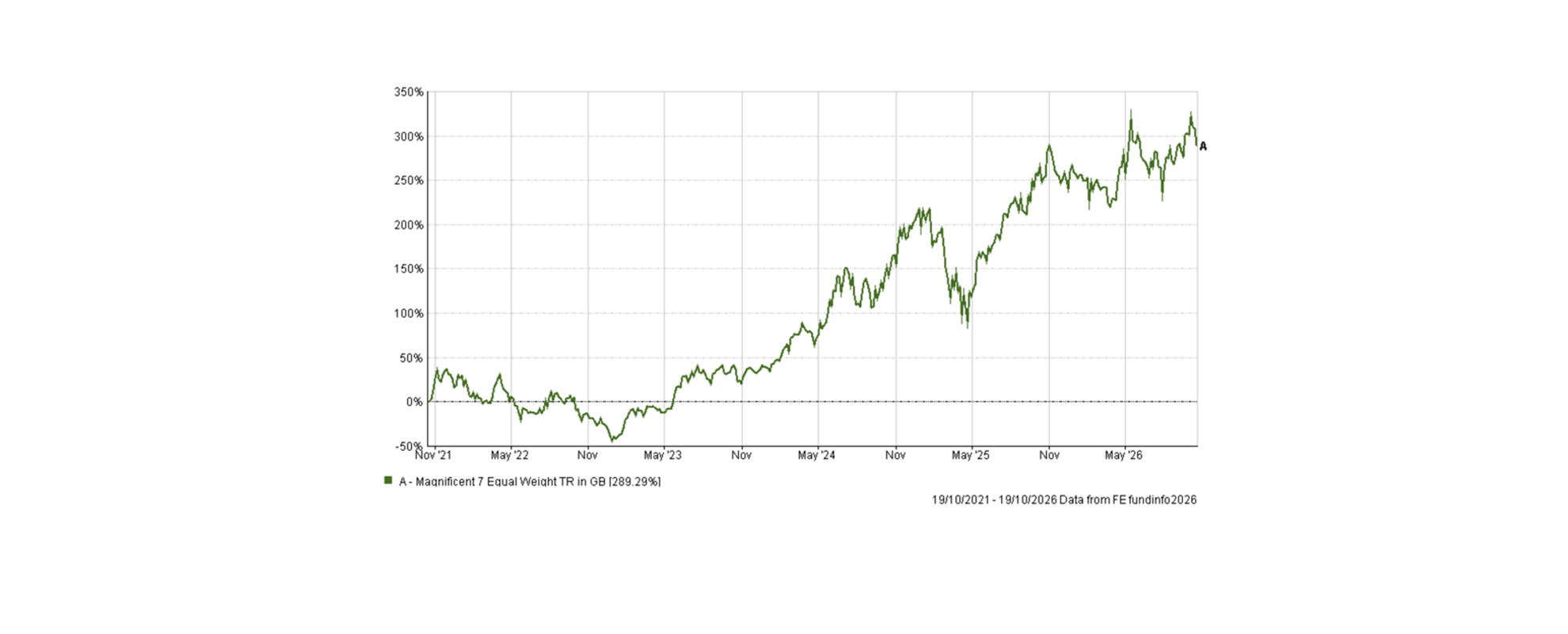
As illustrated, an equally weighted index (14.29% in each company) has returned an impressive 289% over the past five years. Of course, no investment portfolio should be constructed with just these companies in mind. All seven are based in the US and, despite operating across different industries, there is insufficient diversification across sectors and geography.
That being said, investors in these companies have experienced strong returns over this period.
However, their success also highlights an important investment lesson. Today's strongest performers are not always tomorrow's and past performance is not a reliable indicator of future result, which is why maintaining a diversified portfolio remains an important part of long-term investing.
So, what has driven this impressive performance?
There have been a number of factors at play. Earnings have grown strongly, but perhaps just as important has been the expectation of what these companies might earn in the future. The rapid development of artificial intelligence has only added to this enthusiasm, with several of the Magnificent Seven seen as some of the biggest potential beneficiaries of the AI boom.
For those concerned with existing valuations and whether these companies find themselves in a bubble, there is a very real distinction between this and the dot.com bubble seen in the late 1990s which is an important distinction to understand.
The dot.com bubble was driven largely by excitement surrounding the internet, with many companies achieving significant valuations despite having little revenue and no profits. While the internet ultimately transformed the global economy, many of the businesses attracting investment at the time failed to develop sustainable business models.
Today, many of the companies benefiting from AI adoption are well-established businesses with strong balance sheets, significant cash flows and dominant market positions. The Magnificent Seven are investing heavily in AI, but their valuations are supported by existing businesses that generate substantial profits.
The bigger question is whether the expectations already built into their share prices can ultimately be justified. That doesn’t mean their valuations cannot become stretched or that there won’t be bumps along the road. Investing, after all, is rarely a smooth journey.
However, shorten the time horizon to just the past year and the picture starts to look a little different and begs the question: Are the Magnificent Seven still quite so magnificent?
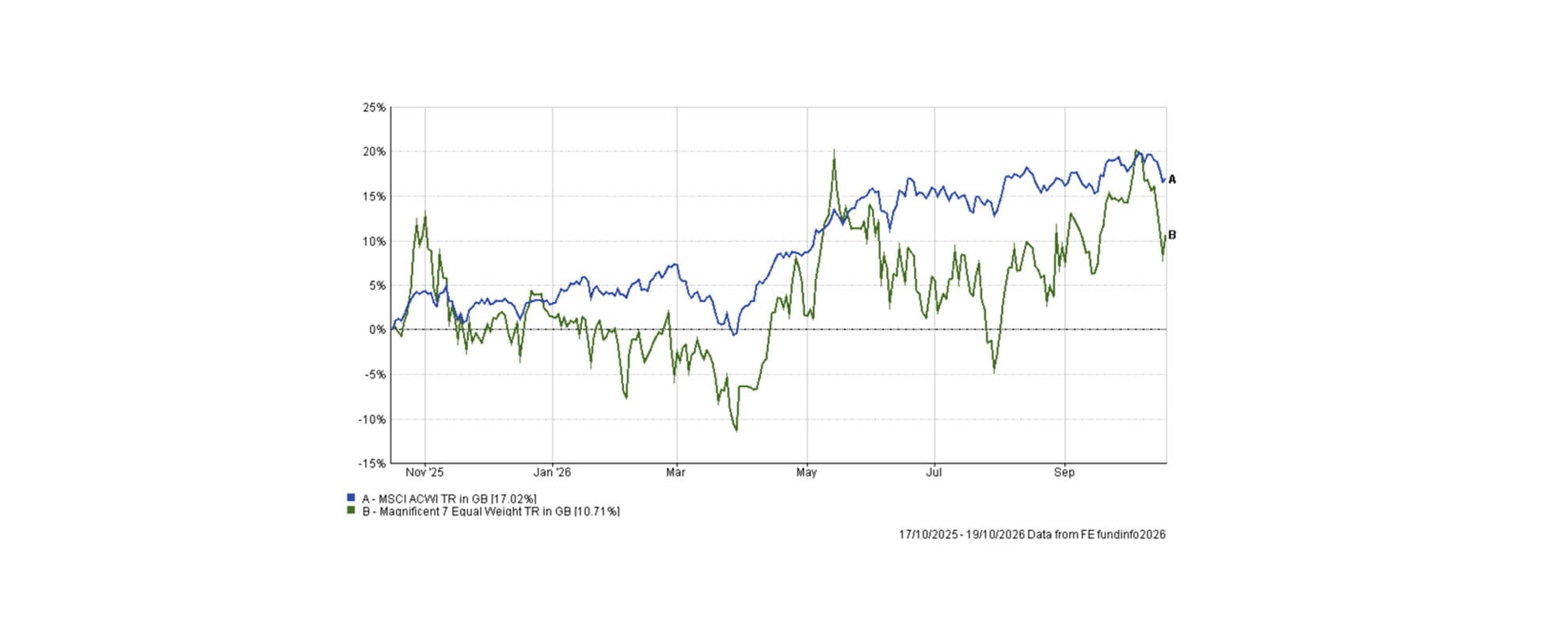
Despite the AI investment boom rarely being far from the news cycle, the equally weighted Magnificent Seven have returned 10.71% over the past year. A perfectly respectable return, but one that falls slightly short of the 17% delivered by the broader MSCI ACWI Index. Perhaps more striking has been the journey along the way, with the Magnificent Seven experiencing considerably more volatility than the wider market.
This isn’t necessarily a bad thing. While share prices have been relatively subdued, earnings across many of the Magnificent Seven have continued to grow, allowing earnings to catch up somewhat with the expectations that had previously been reflected in their valuations. In simple terms, some of these companies have been growing into their share prices.
Why the AI opportunity may be broadening
Perhaps part of the reason is that the AI investment story itself is beginning to broaden beyond the obvious winners. While businesses such as Nvidia have been among the most visible beneficiaries of AI investment, investor attention is increasingly broadening to include the infrastructure that supports these technologies, from data centres to the systems needed to store and process vast amounts of information.
The growth of AI is already beginning to influence everyday technologies. For example, autonomous vehicle technology continues to develop, increasing demand for the computing power and data infrastructure needed to support it. You may have seen that Uber have recently launched the UK’s first robotaxi in London. However, what many people won’t know is that one hour of autonomous driving can generate an astonishing 40 terabytes of data, the equivalent of around 500 million emails. It goes without saying that the infrastructure required to store, process and manage the enormous amounts of data being generated will increasingly find itself in the spotlight.
What does this mean for investors?
And perhaps this is the important point. The Magnificent Seven remain some of the most influential and financially successful businesses in the world and there is little to suggest that AI will disappear from the investment landscape anytime soon. However, as the opportunity begins to broaden, the winners of the next five years may not necessarily be the same as those of the last five.
The Magnificent Seven may continue to play an important role in market returns. However, the experience of the past 12 months highlights the value of looking beyond a small group of companies. While individual winners are difficult to predict, diversification can help investors participate in opportunities wherever they emerge.
Important information
This article is for information purposes only. It is not intended as investment advice.
Fees, charges and eligibility criteria apply.
The value of investments and any income from them can fall as well as rise, and you may get back less than you originally invested.
Any views expressed are our in-house views as at the time of publishing.
This content may not be used, copied, quoted, circulated or otherwise disclosed (in whole or in part) without our prior written consent.
Recommended for you

Active vs passive investing: Why active management still matters in changing markets

What’s going on with bond yields, and what could it mean for you?

How your risk profile shapes your investment choices